
Shortly after ChatGPT burst onto the scene, Google rolled out AI Overviews and then AI mode, surfacing AI-generated answers directly in the search results.
This fundamentally changed the nature of SEO (Search Engine Optimization). Gone are the days of acquiring traffic via keyword-optimized articles. We’re in a whole new world now—one where intelligent AIs scan the web, ingest your content, and summarize it directly to users without them ever needing to visit your website.
This poses a dilemma: If internet users eventually get all their info from AI, without needing to visit a website, how will they learn about your products and services?
Enter GEO, or “Generative Engine Optimization”.
The “new SEO”, GEO promises a set of techniques and tactics to ensure your brand is cited by AI “generative engines” and recommended to users.
The problem? LLMs are not deterministic “if this then that” algorithms that can be gamed. They don’t care about keywords, and they have their own way of reasoning about complex topics. They are probabilistic, black boxes that are difficult to predict and understand.
What’s worse? Most GEO advice out there is guesswork, having little to no data behind it!
So then, what do we do?
Back to basics
I decided to tune out the noise and go back to basics to try to piece together the factors that actually matter for discovery in AI search. Here are the sources I consulted:
- Google’s in-depth SEO documentation – This is a goldmine for understanding how search engines discover and index your content, the ins and outs of schema structured data, how Google thinks about content quality, EEAT, and much more.
- ChatGPT/Claude documentation – Important technical context regarding how LLMs actually work, how they perform searches, and how they retrieve content.
- Research studies – The gold standard for evidence-based factors that actually matter in AI search.
- Data-backed findings from top SEO tools – SEO tools like Semrush and Ahrefs have more search data than anyone. When they publish studies, I take note.
After piecing together my findings, I formulated a framework consisting of 7 “pillars”.
The 7 pillars of GEO
The “7 pillars of GEO” are the primary factors that I believe contribute to having a meaningful presence in AI search. Within each pillar are several individual metrics that can be assessed and measured. But before we get to that, let’s unpack each pillar:
1. SEO fundamentals
Surprise, surprise—SEO fundamentals are still important! Ensuring a strong technical SEO foundation means you’re set up for success. This is the base layer of a solid and durable GEO strategy.
This pillar includes metrics such as schema structured data coverage, absence of 404 errors, optimized sitemap, correctly formatted robots.txt file, and correct use of canonical tags.
2. AI readiness
I use “AI readiness” to refer to basic, foundational principles that will help ensure you aren’t missing anything obvious when it comes to optimizing for AI retrieval and extraction.
For example, your site should render without JavaScript, URLs and meta data should be descriptive and readable, content should be kept up to date, your HTML structure should be clean and logical, and your website should be properly indexed in Bing.
3. Website optimization
GEO isn’t solely about the content itself. There are also technical aspects of how your website is set up that can affect an LLM’s ability to retrieve and synthesize your content.
For example, fast server response times are crucial for on-the-fly retrieval and inference.
4. Content quality
For LLMs to cite your content, they need to be able to read and ingest it. Content quality isn’t just about producing helpful content that adds value to users. It’s about using a clear structure that aids LLM extraction.
Key factors to consider here are relevance, formatting (tables, lists, subheadings), the presence of navigational elements like tables of contents, and consistency in tone, structure and terminology.
5. Trust & authority signals
Google uses a framework called EEAT (Expertise, Experience, Authoritativeness and Trust) to assess websites for content quality. Much of the early EEAT updates, I believe, were setting the stage for AI search.
After all, if LLMs continually cite incorrect facts, or provide substandard answers to questions, nobody would use them. Google, and other AI providers are incentivized to cite brands they deem trustworthy in order to strengthen the quality of responses.
Trust and authority signals include having a clear “About” page, providing detailed bios for blog authors, and having positive reviews on third-party review sites like G2 or TrustPilot.
6. Expertise signals
While trust and authority signals are brand-focused, expertise signals are contributor-focused. When I land on a blog post and see it was written by “Admin”, I don’t read any further. I want to know who the author is and why I should give them my precious time. I want to know that their writing is backed by genuine expertise.
At a systems level, Google relies on entity understanding to make sense of content across the web. Its Knowledge Graph connects people, brands, and topics into structured entities, allowing Google to contextualize who is speaking, what they’re known for, and how they relate to a subject.
These signals are very important as they feed into broader assessments of quality, authority, and trust.
7. Digital footprint
For LLMs to know about your brand, you have to be active on the web. In fact, 85% of brand mentions in AI search come from external domains. Therefore, having a wide “digital footprint” can aid AI discoverability.
In particular, LLMs love structured content and databases like Wikipedia, Crunchbase, G2, and LinkedIn. These websites are goldmines for LLMs seeking up-to-date information on technology brands and products.
Critical factors
While the 7 pillars above represent the key factors that brands should focus on to ensure a robust and defensible presence in AI search, there are several “critical factors” that can make or break a good GEO strategy.
- Robots.txt blocking AI crawlers – LLMs like ChatGPT obey robots.txt directives. If you’re inadvertently blocking them, they will never see your content.
- Site has no structured data at all – Correctly implemented structured data aids in AI extraction. Not including structured data for product pages, authors, and FAQs is a serious error.
- Brand search does not return brand site – If your website doesn’t appear at or near the top of the search results for your brand name, this implies entity confusion or weak brand signals, limiting how well your brand is recognized and cited.
- Site uses JavaScript rendering without fallback – If your website cannot render without JavaScript, it becomes less reliably accessible to crawlers and AI retrieval systems.
- Site lacks “About” page – While not strictly required, the absence of a well-optimized About page makes it harder for search engines and AI systems to establish entity context and assess credibility.
- Site lacks named authors – When content is published without clear author attribution, it becomes harder for search engines and generative systems to assess expertise and authority.
- High quality content is noindexed – If high-quality content is noindexed, it is effectively removed from the pool of material that search engines and AI systems rely on.
- Several high quality pages are hidden at high crawl depth – Content that sits several clicks away from the homepage is less likely to be discovered, crawled frequently, or treated as important.
GEO audit template
To ensure these insights are actionable, I’ve compiled all of my research into an audit template consisting of over 130 individual, weighted metrics that can be measured and scored using basic SEO/online tools.
You can use this audit template to assess your brand’s GEO strength and measure how well-aligned your website and content are to the demands of AI-first search.
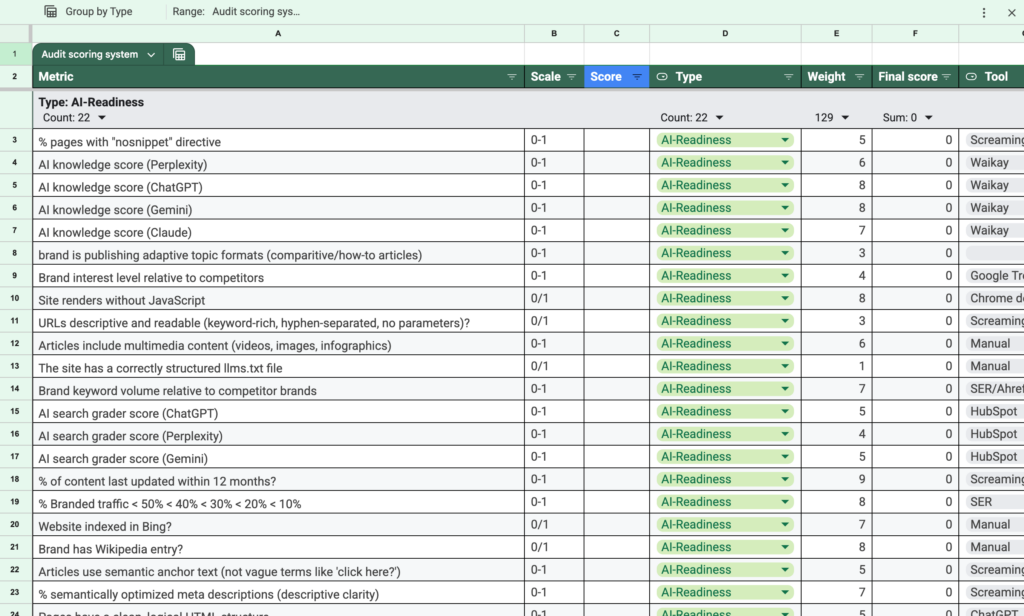
Access the audit template here >>
I cannot stress enough that this is very much a work in progress, representing my current thinking on how best to assess a brand’s foundational strength in the context of GEO.
Feel free to use this template as-is, or customize it as you see fit.