
Content is the growth engine for most WordPress companies. For many, organic search drives the majority of new customers. But succeeding with content in this space isn’t easy.
WordPress companies face unique challenges: serving both technical and non-technical audiences, competing in a crowded market with low barriers to entry, and finding the right balance between education and product promotion.
That’s why a strategic framework is essential. I’ve developed one that provides a solid foundation for building content strategies that are not only comprehensive, but scalable and performance-driven.
Why so many WordPress companies get content wrong (and how to fix it)
Before diving into the framework, let’s address the elephant in the room: many WordPress companies treat content as an afterthought. They publish sporadically, chase trends, and focus on content they think is useful instead of asking their customers what they want.
This underscores the importance of having a solid content strategy before embarking on the content creation process. When you align content with your business goals and user needs, it becomes your most powerful growth engine.
The PPApER Framework: your content strategy blueprint
I’m a big fan of simplicity, and I love frameworks. So when I thought about my experience designing and implementing content strategies, I realized I nearly always follow the same 5 steps.
Therefore, I’ve structured this approach around a framework I call PPApER:
- Planning (understanding your audience and business goals)
- Preparation (researching content types and channels)
- Alignment (prioritizing content in alignment with business goals)
- (precise) Execution (the actual content creation)
- Recalibration (continuous improvement)
Seeing as this article is primarily concerned with strategy, I’ll walk through phases 1–3 and leave phases 4–5 for a future post.
Phase 1: Planning
Step 1: Consider your WHY, WHAT, and HOW
Start by considering the 3 core components of any strategy. (There’s no need to define these now—you will do this as you progress through the framework).
- WHY → Your overall content philosophy and how it intersects with your business goals.
- WHAT → The core components of your strategy. Here you need to be ruthless in determining the scope of your strategy (creating content for every channel under the sun is not only unrealistic but a waste of resources).
- HOW → Your execution roadmap, including the important objectives you need to hit along the way, and the resources you will deploy to get there.
We’ll touch on each of these more as we progress.
Step 2: Define your growth model
When it comes to content and SEO strategy, renowned growth consultant Kevin Indig distinguishes between two primary approaches—integrators and aggregators. Determining which category your business falls into is paramount to building an effective content strategy.
Here’s a brief primer:
Integrators:
- Content is crafted to attract, inform, and build direct relationships with users.
- Growth comes from being uniquely valuable, not sheer scale.
- Focus on creating differentiated, educational content that showcases unique expertise
Examples: Elementor’s Academy, Kinsta’s education-focused blog
Aggregators:
- Leverage user-generated content or data
- Scale through programmatic content creation that seeks to cover many long-tail queries
- Drive value and competitor differentiation through unique datasets and inventory that others don’t have
Examples: WordPress.org’s plugin directory, theme marketplaces
Most WordPress companies (e.g., plugin & theme developers) benefit from an integrator approach.
Phase 2: Preparation
As Abraham Lincoln once said, “Give me six hours to chop down a tree and I will spend the first five sharpening my axe.” The same principle applies to content strategy: the better your strategic foundation, the more effective every piece of content becomes.
Preparation is a key step that often gets overlooked. In this phase there are several important steps that don’t necessarily need to be completed in any particular order.
Step 1: Determine your highest value content and channels
Some companies make the mistake of letting keyword search volumes dictate the content they create. This is not the right approach! Content has to appeal to your target users. Therefore, your primary focus should be the audience for which your content is intended.
That said, I advocate for using both audience research and keyword research to inform the content you create. This ensures you’re not only targeting high-traffic search terms, but you’re creating content that actually helps your users.
Moreover, by layering in your unique value proposition and brand voice, you can differentiate your organization and avoid creating content that can be easily replicated.
Audience research
Is my target audience technical or non-technical? Where do they hang out online? What are they trying to achieve and how could my content help them?
Tools: Support tickets, SparkToro, Reddit, surveys, competitor case studies.
SEO keyword research
What are the most relevant search terms? What questions are users asking on Reddit and other forums? What searches am I appearing for in AI responses?
Tools: Google Search Console, Ahrefs, Semrush, AnswerThePublic.
Unique value proposition
What do we provide that competitors don’t? Why do customers choose us? What unique expertise do we offer? What unique data do we have access to?
Brand voice
Is our brand playful, authoritative, conversational, quirky, or neutral? How can we stand out through tone and writing style alone?
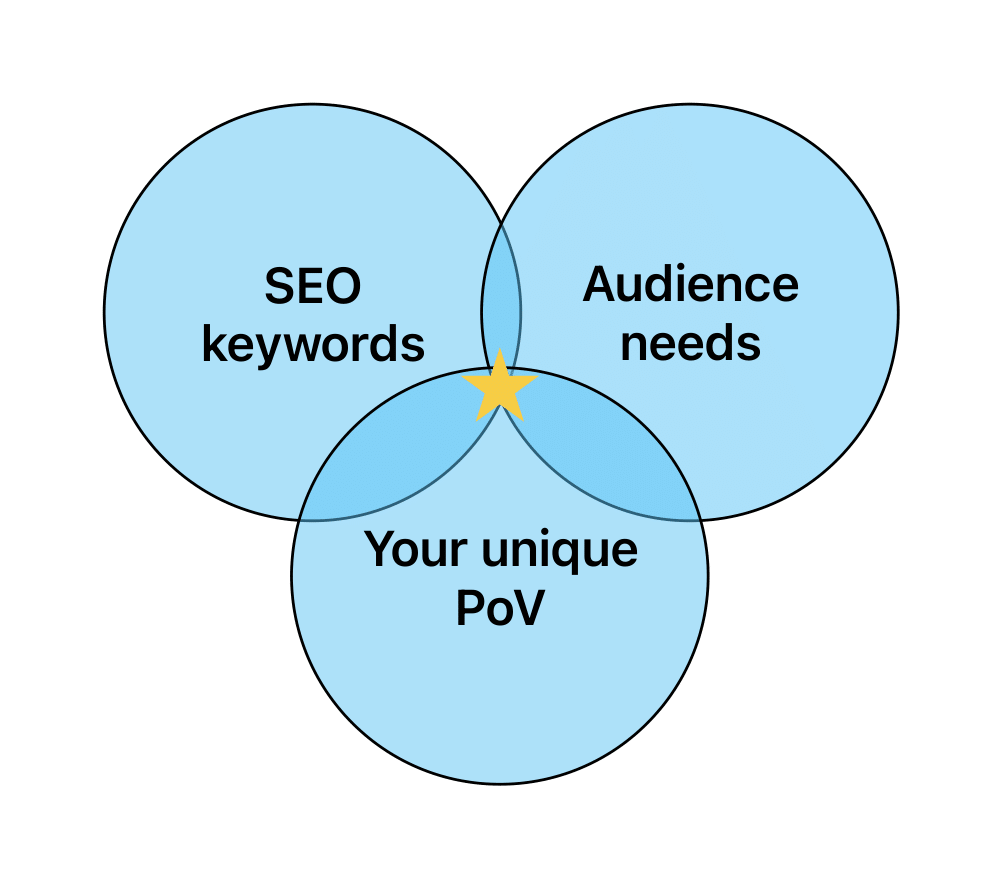
I’ve found that the sweet spot for most WordPress companies is focusing content around a product-led approach. Very simply, product-led content is content that helps the reader solve their problems using your product.
Step 2: Map content types to the customer journey
Now we can start drilling into content types. You can’t tackle everything at once—prioritization and focus are key, especially for smaller companies.
This is where your business goals come in: looking to reduce churn? Focus on educational content. Trying to attract new customers? Product demos or case studies will make a bigger impact.
But start brainstorming content types first with the intention of narrowing things down later. Here are some examples of popular content types for WordPress companies:
| Example content type | Why it matters |
|---|---|
| Technical Documentation | Your users need clear, searchable help content |
| Educational Content | Build authority and trust in the WordPress ecosystem |
| Product Comparisons | Help users understand your unique value |
| Community Content | WordPress thrives on community engagement |
| Video Tutorials | Complex features often need visual explanation |
| Case Studies | Social proof is crucial in B2B WordPress space |
| Webinars | Build trust and engagement by giving prospects a live, interactive learning experience |
| Product demos | Show exactly how your product solves real problems, reducing friction in the buying decision |
| Thought leadership | Positions your company as an expert, attracting attention and credibility in your market |
Next, map the customer journey. Where are you weakest, or losing the most prospects? Also, factor in your available resources—focus on what you can realistically execute well.
Frameworks like Avinash Kaushik’s See-Think-Do-Care can help identify gaps and prioritize which content types will have the biggest impact. Here’s a simple example:
See (Awareness):
- “What is [your solution category]?”
- WordPress ecosystem trends and insights
- General educational content
Think (Consideration):
- “[Your product] vs [Competitor]” comparisons
- Implementation guides
- Best practices and methodologies
Do (Decision):
- Product demos and walkthroughs
- Pricing explanations
- Getting started guides
Care (Retention):
- Detailed technical documentation
- Feature announcements
- Community spotlights
Step 3: Get your technical infrastructure in place
Before you start creating content, make sure your website is built to support it. The right technical setup ensures your efforts don’t get wasted and that content performs as intended.
- Does your site have the correct post types set up?
- Is your site well-optimized for readability and accessibility?
- Have you taken SEO into account? Is your site accessible to search engines, and AI agents?
- Does your website demonstrate expertise? Have you considered EEAT?
Having a solid technical architecture in place and a clear outline of the content that you need to create ensures your axe is sharp and implementation is smooth.
Phase 3: Alignment
Step 1: Prioritize content creation
Prioritization is key, especially for WordPress companies with limited resources. Focus on content that balances impact and feasibility. Consider these three factors when deciding what to create:
- Feasibility: Can you produce this content with the resources you currently have?
- User value: Does it genuinely address the needs of your audience?
- Business potential: Does it have potential to drive meaningful outcomes aligned with your business goals?
Step 2: Create an execution roadmap
A roadmap ensures every piece of content serves a clear purpose and promotes accountability. Content is a long game, and consistency is key. Structure your roadmap by tying objectives to a timeline and content type:
| Q1 | |||
|---|---|---|---|
| Month 1 | Month 2 | Month 3 | |
| Product demos | Record 3 short demo videos covering core features | Publish 2 in-depth walkthroughs | Host 1 live demo webinar for prospects |
| Educational content | Publish 2 beginner guides to onboard new users | Publish 3 technical tutorials that generate 200+ engaged readers each | Create 1 comprehensive how-to guide addressing top user questions |
Find inspiration by studying success stories
Taking inspiration from successful content & SEO strategies can help inform your own approach. Although these aren’t WordPress companies, here are some excellent case studies that I think are well worth studying:
Final thoughts
Content strategy for WordPress companies isn’t about gaming algorithms or chasing traffic. It’s about creating resources that genuinely help your users succeed, while showcasing your expertise and building trust.
The WordPress community rewards those who contribute real value. When you focus on solving real problems for real users, growth naturally follows as a byproduct.